
The Sporting Nationality Dilemma: Which Jersey Would You Wear?
Introduction: The Identity Crisis in Modern Sport Imagine an athlete born in one country, raised in another, and holding citizenship in a third. In the high-stakes arena of international competition, which jersey should they wear? This question sits at the heart of sporting nationality, a concept that has evolved from the early days of the Olympic Games—where transnational teams once competed under a single flag—into a complex web of legal and regulatory frameworks.
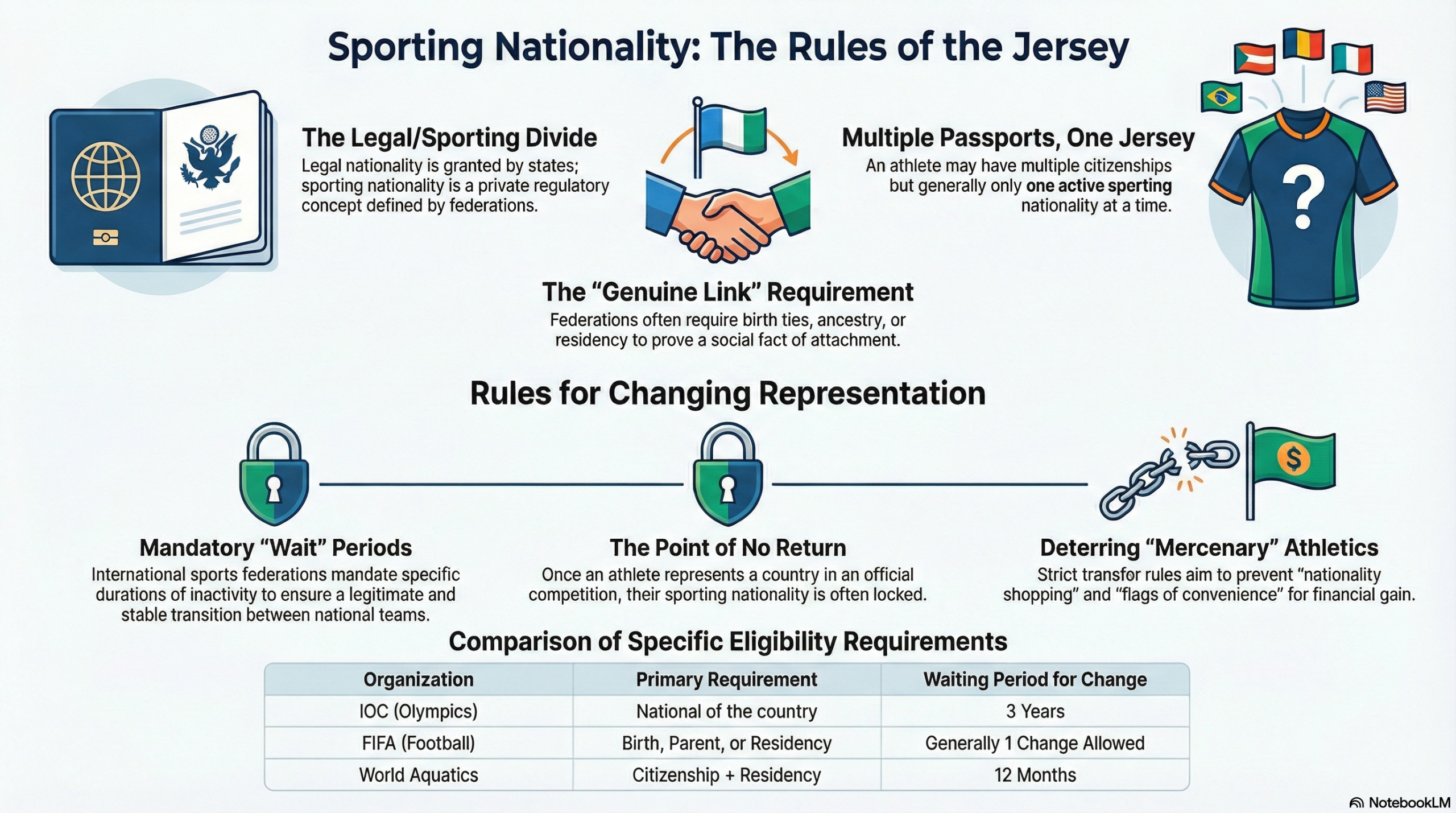
- Defining the Concept: Legal vs. Sporting Nationality Sporting nationality is essentially twofold: it is the eligibility concept used to define participation in international events, and it is the legal relationship between an athlete and a national governing body.
A critical distinction must be made between legal nationality and sporting nationality.
- Legal Nationality (Citizenship): Determined solely by sovereign States under public international law.
- Sporting Nationality: Regulated by international sports governing bodies (like FIFA or the IOC) within their own private law systems.
While a person may hold multiple legal nationalities, the Court of Arbitration for Sport (CAS) has noted that an athlete typically has only one sporting nationality at a time. However, because each federation maintains its own rules, an athlete could theoretically have as many sporting nationalities as there are governing bodies in their sport.
- The Rules of the Game: Different Sports, Different Standards There is no universal standard for sporting nationality; instead, “different sport, different eligibility rules” is the prevailing reality.
- The International Olympic Committee (IOC): Under Rule 41 of the Olympic Charter, a competitor must be a national of the country of the National Olympic Committee (NOC) entering them. While dual nationals may choose which country to represent, once they have competed for one, they generally cannot switch for three years without specific agreements and waiting periods.
- FIFA (Football): Eligibility is governed by the FIFA Regulations Governing the Application of the Statutes (RGAS). A “genuine link” must be established, often through birth, parentage, or a minimum period of residence. Notably, any physical presence on the pitch in an official match (the “cap-tie”) can bind a player to an association for their career, though a change of association may be permitted once under strict prerequisites.
- World Aquatics & Badminton: World Aquatics requires a 12-month waiting period and uninterrupted residence for a change of nationality. Badminton (BWF) focuses on passport requirements and a three-year non-representation period before switching.
- Team Limits: Some sports impose quotas on naturalized players. For instance, Basketball (FIBA) allows only one player who acquired nationality after age 16 per team, and Handball limits teams to two such players.
III. Case Studies: Putting Rules into Practice The practical application of these rules is visible in the careers of world-class athletes:
- Football: Diego Costa represented Spain after playing friendlies for Brazil; Riyad Mahrez plays for Algeria (his father’s birthplace) despite being born in France; and Raheem Sterling represents England after moving there from his birthplace, Jamaica.
- Athletics: Maryam Jamal, born in Ethiopia, became the first Bahraini to win an Olympic medal after being granted citizenship in 2004.
- The Malaysian Context: In Malaysia, naturalization is governed by Article 19 of the Federal Constitution, requiring applicants to be over 21, of good character, and resident for at least 10 of the preceding 12 years. This process is distinct from the “heritage player” status determined by FIFA statutes.
- The Legal Backbone: Insights from the Court of Arbitration for Sport (CAS) CAS jurisprudence emphasizes that while states have the right to determine their own nationality rules, federations can define additional criteria for competition. Rulings have supported the objective of preserving the link between national teams and their countries to avoid “sporting mercenaries” acquiring “nationalities of convenience”.
- Ethical Considerations: Commerce vs. Connection The phenomenon of “country swapping” or “nationality shopping” has raised significant ethical concerns. Terms like “quickie citizenship” and “athletic mercenaries” describe athletes who represent nations with which they have no prior relationship.
To counter this, federations are increasingly demanding that nationality reflect a “genuine link“—a “social fact of attachment” involving interests and sentiments. Waiting periods serve two main purposes:
- Ensuring Fairness: Preventing sudden, unexpected team changes that could endanger the integrity of competition.
- Deterring Commerce: Discouraging the “unethical commerce of nationalities” where talent is sold to the highest bidder.
Conclusion:
The Spectator’s Perspective While regulators focus on integrity, some argue that spectators are the “collateral losers” when mobility is restricted. From this viewpoint, competition would improve if athletes enjoyed free mobility, ensuring that tournaments are filled with the most qualified individuals regardless of their passport. Ultimately, sporting nationality remains a delicate balance between the sovereignty of nations, the regulations of sports bodies, and the personal identity of the athlete.
Recent Comments